Between August 2008 and April 2018 I spent a number of years working on Signy Island (South Orkney Islands) and Bird Island (South Georgia) for the British Antarctic Survey (BAS). I worked as a Zoological Field Assistant on the penguin, seal and albatross long-term monitoring programme. After a 5 year break, I headed back down to Bird Island in Janary 2024 for another dose of penguin work and in November 2025 I returned to Signy Island for 2 months.

This blog gives readers an insight into my day-to-day life in the Antarctic, from my first trip south in 2008 to the present day.

Tuesday, 1 December 2015

Arrival

After a couple of days moving very slowly through the ice, we finally arrived in a small patch of open water, just off Signy Island, where our research station is situated.  The first day, which felt very wintery, a handful of us went ashore in small boats, to check out the situation and see how things were.  Lying on a tectonic plate boundary, the area is prone to small earthquakes and this, coupled with being left entirely unattended for the Antarctic winter means we had no idea what we might find when we first visit the station. 

This year all was well.  All the buildings were how we had left them.  The snow had drifted deeply around some of the buildings, so first jobs were to start digging to get into the buildings so we could open up the station.


At night we returned to the ship as the station was still cold and dark.  The next day, we all went ashore to start opening up the station properly.  This is hard work and requires a lot of people.  Although there are only 8 of us staying at Signy, there are plenty of willing people, bound for other destinations or part of the Science cruise, on the ship who are keen to dig snow, move boxes and generally help out to get things up and running.

First jobs are to continue digging and to remove shutters from the windows to give us some light.  Meanwhile the techies get started warming up the generators.  The temperature at Signy can get down to -30 degrees centigrade during the winter so we cannot just switch them on.  After a few hours, once they are warm and dry, these can be tentatively fired up.  Once we have power, the heating systems can be started, as can the lighting, and the sea water pumps which allow us to have flushing toilets. 

While the techies are busy, our next job is to get the cargo ashore.  This is all the food (fresh, frozen and dried), science equipment, personal bags, and supplies for the station; enough to last the entire season.  This all has to be brought ashore and man-handled to the right building on station.

The sea around Signy is too shallow for the ship, the James Clark Ross to get very close.  Therefore all cargo that comes ashore is brough in the Cargo Tender- a small landing craft with a crane.   Often the tender can get to the small jetty at the station, but this season the sea ice was still in the bay so everything had to be dropped further along the shore and moved along to the station (you can see the sea ice in the bay, on the left in the picture below). 


Luckily, we have a couple of skidoos, and the large volume of snow this year meant we could use these, making the whole process much easier!  


By the end of the day we had most of the cargo, heating, lighting, and toilets so were able to move off the ship and into our new home.  The Reverse Osmosis Plant, which produces freshwater from seawater, was up and running, but it takes a few days for us to produce enough to be able to fill the tanks and start using it so water is pretty scarce. 

The next day was spent unpacking boxes while the ship waited offshore.  It was too windy for them to launch the boats.  The day after however, the final cargo was brought ashore and everything was finished.  The ship sailed off, heading for South Georgia, leaving 8 of us ashore, and we settled down to the rest of the unpacking, and to get started on the science we have come here to do.    


Friday, 27 November 2015

The journey

The journey from the Falkland Islands, down to Signy is usually a 3 day crossing.  We left Stanley on a beautiful calm evening, heading South East across the Drake Passage towards the South Orkney Islands. 


After a couple of days of fairly bumpy seas, we hit the colder Antarctic ocean currents, and ice started to appear.  At first, just little pieces, but then increasingly larger icebergs appeared.


Icebergs are made of fresh water carved from glaciers, and can float around in the ocean for several years.  In the winter, the surface of the sea itself freezes, locking these big bergs into the sea ice, until it melts the following spring. 

Signy lies just at the outer edge of the northern limit of the Antarctic sea ice, so it, and everything south of it, is linked to the frozen Antarctic continent during the deepest of winter months when the sea ice extent is at its greatest.  In the summer the sea ice melts and Signy is surrounded by open water. 

As the research station is uninhabited during the winter, upon arrival at Signy in the Spring, we have no idea whether it will be still locked into the sea ice, or have open water.  This year we reached the edge of the sea ice only a few miles from Signy. 


The ice was breaking up, but still very densely packed in a lot of places, making progress exceedingly slow as the ship picks its way carefully through.  One day we covered only 4 miles. 


At the back of the ship the ice quickly closes back in after passing through it, leaving a very real sense of being in the middle of nowhere.


At night the ship continues, with the aid of bright navigational lights. 


After two days of ice, we finally reached Signy, which conveniently had a small area of open water around it, allowing us to access the research station by launching the small boats.  Upon arrival, our task was to get the research station up and running and ready for the coming science season.    


Sunday, 22 November 2015

Signy 2015-16 Season

My trip this year began on 5th November, when I left the UK and flew South.  Dates and timings always change at the last minute, and in the end we flew to Sao Paulo, then on to Santiago, then continued South to Punta Arenas, and finally across to Stanley in the Falkland Islands.  In Stanley we joined the ship, the RRS James Clark Ross.  The James Clark Ross (JCR) belongs to the British Antarctic Survey and is mainly a scientific research vessel, but also transfers people and equipment (like us) to their respective research stations.


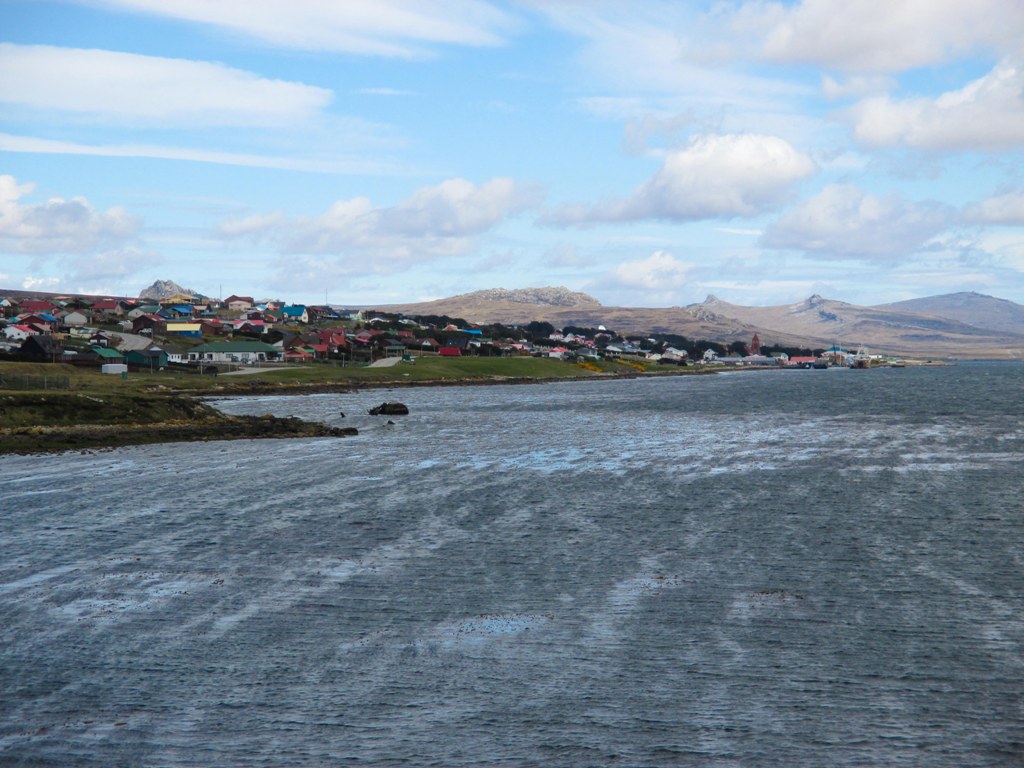
Stanley is where most of the Falkland Islanders live and is a colourful little town, stretching down to the sea and a small sheltered harbour. 


It is spring in the Falklands and it is always nice to arrive here from a wintery UK to be greeted by tiny lambs, young birds and spring flowers, even if it is still very cold and blowy.  Below are a few common species to be found here.  This is a family of Flightless Steamer Ducks.


The Male sunbathes nearby.


A male Kelp Goose.


A Turkey Vulture.


Nesting Gentoo Penguins and sheep- a combination that I still find rather bizarre!


After a few days in the Falklands, we finally set sail for Signy, South Orkney islands, Antarctica, where I will spend the next 5 months.  More about that coming soon...

Monday, 6 April 2015

Home time...

This year our season came to a rather abrupt end.  With 4 weeks to go, we were suddenly informed that there was concern about the amount of sea ice around, making it tricky to pick us up- as the Ernest Shackleton was in the area, it was decided that they should pick us up early.  This gave us 4 days notice, to close down the station, tidy everything up, finish the science, pack all the boxes to be sent out, and get on the ship.

This meant I had a lot to do- my first task was to get the rest of my penguin nest marker bricks out of the pond and wash them, then stack them into the huts.  I managed to make a hole in the ice big enough to fish them out.


My next task was to start boxing everything up to send out on the ship.  Every piece of cargo has to have paperwork to go with it, and every box has to be labelled on all sides with various information.  As I am Science coordinator, this means I am responsible for shipping out all the lab equipment and biological samples, as well as the medical equipment and various other things.  My lab became my temporary cargo packing area and was a little chaotic for a time, but by the necessary date, it was all neatly labelled and stacked ready for the ship.


We had a final day of fieldwork to complete, which allowed me to finish the giant petrel chick counts.  Afterwards we brought back all the flags that mark a safe route over the icecap.  We also managed to squeeze in a full base spring clean, before starting to decomission the services.  First to go was the reverse osmosis plant which creates our fresh water from seawater.  We have enough water stored to last a couple of days so we can take this apart a few days before leaving.  In the last couple of days, the rest of the water systems are drained down, and every bit of pipework hoovered out to prevent pipes freezing over the winter.  Shutters are placed on the windows and the elephant seal fence is taken down.  All remaining food is packaged up and brought down to the main building as it remains the driest over the winter.  There is a lot for everyone to do.

We were treated to a lovely sunrise on our last morning at Signy.  A moment of calm beauty before the ship arrived and everyone started running around doing useful things.


On the final day, all cargo and waste gets put on the ship, the generators are switched off and serviced, the heating system is turned off, and finally, once the base is shuttered, cold and dark, we lock the door and board the ship.

Here is team Signy heading home (from back left: Rob, Stacey, Iain, Francesco, Keong, Matt, Roberto and Hector), with Signy behind. 


And to finish the season, here is a final (and very lovely) iceberg just off the tip of Signy.
 

We arrived back in the Falklands on 19th March after a rough but uneventful crossing of the Drake Passage.  I have now returned to the UK, where I will be spending the summer working at Foxglove Covert local nature reserve in Yorkshire.  Check back in November to find out if I will be returning to the Antarctic next season. 

Sunday, 1 March 2015

Winter arrives...

After what feels like months of rain and wind, Signy suddenly decided to throw some different weather at us for a change.  The temperature dropped to about -6 degrees and the rain turned to snow.  We awoke one morning to the most gorgeous day, with a good three inches of fluffy, powdery snow covering everything, big blue skies and gusts of wind that made flurries of snow sparkle and form little rainbows.  Signy had changed from summer to winter overnight!  Recently, sea ice has also started blowing in again from futher South, which had been absent for a few weeks now.  All of this, plus the shortening day length has added to the feeling that winter is now well on its way.   


We were treated to some heavy and dramatic lenticular (lens-shaped) clouds over Coronation Island on this day too, which made for some dramatic photographs.  Here is Roberto is a snow flurry.


And here are some of the clouds forming over Coronation Island (you can't see the lens shape, or the way they pile up on top of eachother very well in this picture unfortunately)


Workwise, things are finally starting to calm down a little.  My chinstrap penguins have just started fledging, and in another couple of weeks every one will be gone.  I am being kept busy with chick weighing.  I have also moved all my nest marker bricks (with a little help from my obliging field assistant!) back to the work huts ready to be cleaned.  After this they will be stacked into the huts ready for putting back out into the colonies next season.  The problem I currently have is that the pond where I normally wash my bricks has just frozen over- half the bricks are now frozen into the pond, and the other half are sitting on the ice, waiting for it to melt so they fall in.  I am hoping for another week of mild weather to enable me to finish this task!

Our two Italian Scientists Roberto and Francesco are also hoping for a tiny bit more summer- they are mapping the vegetation and geomorphological features on Signy.  If it snows too much they can't see what they are trying to look at! 

Now that the nights are drawing in, it means that we don't have to stay up ridiculously late to see the sun set.  Here are some good clouds we had at sunset a few nights ago. 


Thats all for now.  Its only about 5 weeks now til the ship comes to pick us up.  Not long now til we need to start thinking about cargo to be sent out and all the things that need to be done to prepare Signy for being left alone for the winter.