Between August 2008 and April 2018 I spent a number of years working on Signy Island (South Orkney Islands) and Bird Island (South Georgia) for the British Antarctic Survey (BAS). I worked as a Zoological Field Assistant on the penguin, seal and albatross long-term monitoring programme. After a 5 year break, I headed back down to Bird Island in Janary 2024 for another dose of penguin work and in November 2025 I returned to Signy Island for 2 months.

This blog gives readers an insight into my day-to-day life in the Antarctic, from my first trip south in 2008 to the present day.

Saturday, 20 January 2024

The journey south

I have now safely arrived and settled in at Bird Island, South Georgia, which is to be my home until April.  The 9000 mile journey began last Tuesday when my luggage and I were dropped off at Darlington train station by Adam and I caught the train down to my parents in Lincolnshire.  The next day my parents took me to Cambridge, which is where the British Antarctic Survey offices and labs are.   Here I met a small group of other BAS staff who were also heading south and we were taken to RAF Brize Norton in Oxfordshire.  Here we met more BAS staff and boarded the plane.  By now our group size had increased to 9 people, all of us heading for South Georgia.

The plane was a relatively ordinary military version of the Airbus A330 (and not a Hercules, which some people have asked me). 


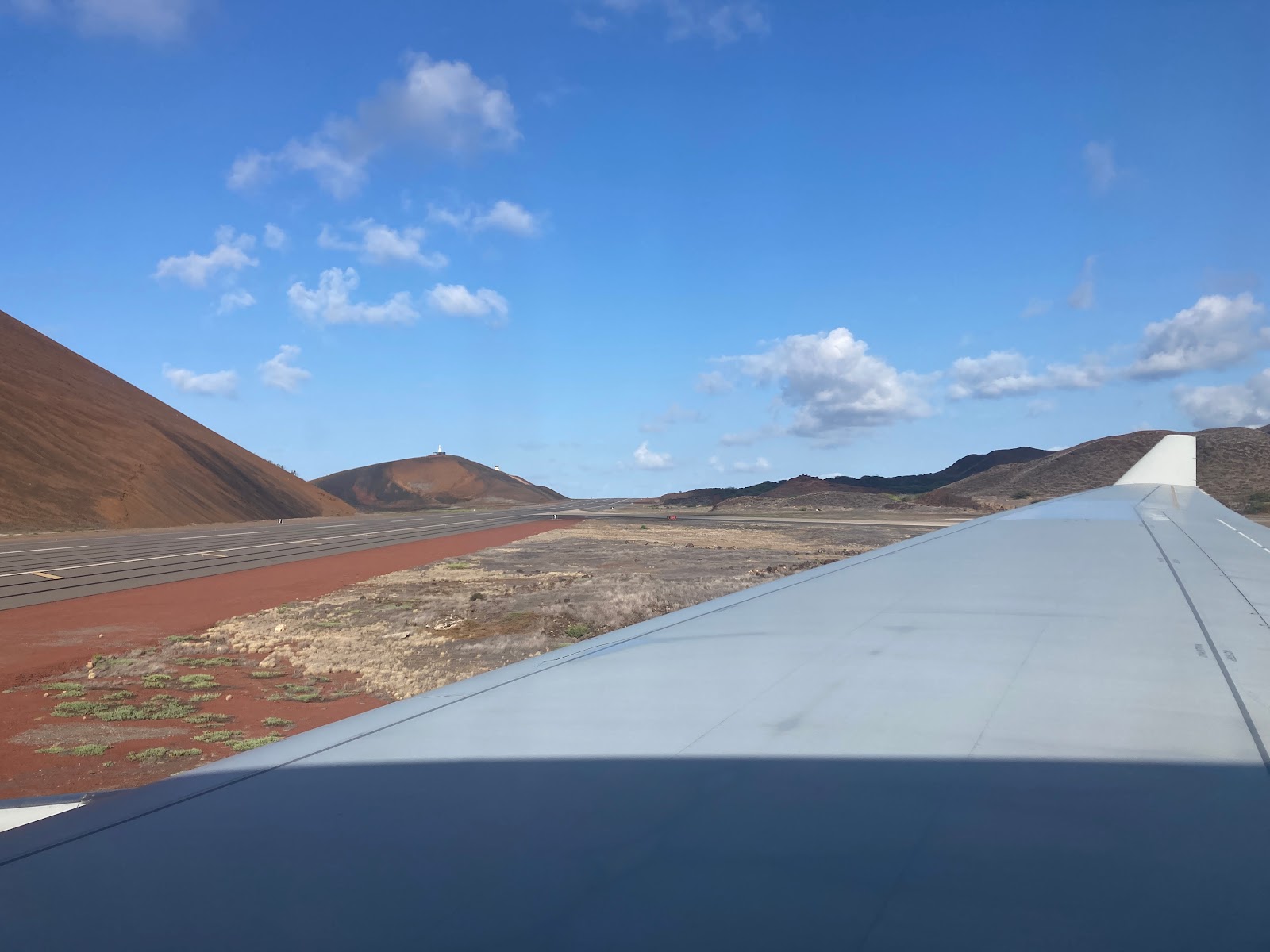
We passed a pleasant journey on a plane that was only half full, which was nice as it meant 2 seats each and just enough space to sleep on the journey.  The journey takes about 17 hours, with a short stop at Ascension Island for refuelling approximately half way there.   Ascension Island is a small rocky island far out in the Atlantic, a little south of the equator, and was a pleasant 26 degrees when we got off the plane. 

Sadly we aren't allowed out of the terminal to explore the island as we're still in transit but it was nice to get off the plane and stretch our legs (I did spend a week on the island on a previous trip so I didn't feel I missed out too much by it only being a very short stop on this occasion).    
Once the plane was refuelled, we continued on our way to Mount Pleasant Airbase in the Falkland Islands.  Another bus journey from Mount Pleasant and we arrived in Stanley, the capital of the Falklands.  The Falklands are windswept and vast (like a larger wilder version of Shetland). 

The majority of its ~3500 inhabitants live in the capital, which sprawls along the seafront, in an array of brightly coloured, mostly wooden-clad buildings.  We spent one night in the Malvina hotel in Stanley, which was just enough time for a walk along the seafront, where I spotted my first penguin and seal.

The next morning we were on the move again (by now it was Friday).  This time onto the MV Pharos SG, the Fishery Patrol Vessel for South Georgia and the South Sandwich Islands.  We spent nearly 3 days onboard, heading from the Falkland Island to Bird Island which lies at the western end of South Georgia.  As the ship is quite small, and the swell was pretty big, the crossing was quite rough, but the time passed pleasantly enough. 

There are two research stations on South Georgia.  Four of us are heading for Bird Island Research Station while the remainder of the group are heading for King Edward Point Research Station.  The group heading there made our journey very interesting- they are whale scientists and were heading there to study humpback whales.  They were a very interesting bunch doing some fascinating science, and kept a permanent watch on the bridge of the ship for whales during the entire journey.  This was great as there was always someone there to tell everyone if whales were spotted.   The journey was mostly spent eating, or watching the birds that were following the ship.  This one is a wandering albatross.

As we got closer to South Georgia, there were quite a few icebergs.  I have never quite got over my fascination for icebergs.  Every one is different and the colours and shapes are ever changing with the light.

We finally arrived safely at Bird Island on Monday, where four of us disembarked the Pharos in small boats to our new home.  We receive a very warm welcome from those currently at the island and quickly settled down to life on station.

Wednesday, 13 December 2023

Back to Bird Island!

After nearly a five year gap, I am very excited to be able to tell you that in January I will be returning to Bird Island, South Georgia, to work for the British Antarctic Survey again.  I’ll be back working with the penguins and other wildlife there for a short (3-month) deployment, returning to the UK in April.

I leave the UK on 11th January.  More details and pictures will follow soon, once things start to happen!

Wednesday, 28 March 2018

The end of the season

With the ship only 2 days away, we are now all busy getting ready to leave.  Fieldwork is complete, boxes are packed and we start thinking about closing down the station itself.

The weather has been beautiful this week which has made a lovely end to a season that has been largely mild, wet and windy.  It has really felt like summer.

Yesterdays sunrise over Coronation Island was well worth going out to see.  Specially as the sun now gets up around 7:15am so it is not even an early start!   

The moon over Coronation in the evening was just as pretty.

The ship is due on Friday and we expect to leave sometime on Sunday, bound for the Falklands.  The Signy webcam will be decomissioned with the services so will vanish shortly, but you can follow my progress home on the Ernest Shackleton ship webcam and ship tracker (links to both of these are under the "interesting links" on the right hand side of this page, although the ship tracker isn't always very good at updating).  We will be onboard until 6th April. 

We fly home on 6th April, from the Falkland Islands, arriving back into the UK on 7th.  I am looking forward to getting home in time for spring.   

Sunday, 18 March 2018

March

It is now March.  For us, March is the end of the season and time to start thinking about going home.  My chinstrap chicks have all fledged.  Unlike the Adelies, who travel south to moult, the chinstrap adults will stay at Signy to moult.  Many of them will stand with their partners on their nest site while they do this. 


Some of them look very scruffy as their new feathers grow and push out the old ones.  Sometimes the ground is littered with so many feathers it looks like it has been snowing.  It takes a suprisingly short time for the entire set of feathers to be replaced (only 2 weeks).  I always feel that this is the equivalent of going out and buying a brand new waterproof coat for the winter months. 


The fur seals also moult at Signy.  They also look scruffy, often looking like they need a good hoovering!

The elephant seal fur seems to peel off in layers rather than individual hairs falling out.  They always look very smart once they have moulted.  This youngster looked particularly nice. 


It always seems a shame to me that they grow into something like this!

My fieldwork is now complete.  Instead jobs now include things like giving my field huts at Gourlay a new coat of wood preserver (although this year we only had enough to do the hut on the right).

I've also just finished the job of washing my nest marker bricks.  This year the sun shone and it was a pleasant task.

Now they are all stacked in the hut ready for next season. 


The weather has improved slightly in recent weeks, becoming colder and clearer.   One evening we even had a sort-of sunset...


... followed by a dark night with millions of stars.  This is only the second night I've seen stars this year, due to a combination of it being summer and therefore light, and then being largely overcast.  It now gets dark quite early, giving us more opportunities to see the stars.

With very little snow left after a mild season, some areas of Signy look nothing like the Antarctic!  Some of the thawed lakes look particularly nice, with the water a deep greeny blue colour from the glacial sediments that drain into them. 


With 10 days to go now before the ship comes to pick us up, we turn to packing cargo and samples and starting to close down the station for the winter.    

Friday, 9 March 2018

Counting

A lot of my job involves counting and monitoring a variety of wildlife.  The counting part of this has been particularly noticeable over the last couple of weeks. 

First job was the whole island seal census.  This involved all personnel on station, and took two full days.  Every seal on the island, of every species, was counted.  Some areas have a lot of seals and many of the fur seals look remarkably rock-like! 

The beaches and low lying areas are particularly popular with the fur seals and elephant seals.

While the ice flows are much more popular with seals such as this leopard seal and weddell seals.

The seals have been counted almost every year, at the same time of year since 1977, allowing us to see the long term trends in their numbers.  We got to just over 9000 seals in total this year. 

Whilst out counting I came across this south polar skua. 

Only a few of these nest on the island here.  Most of the skuas here are the larger and darker, Brown skua.  This picture shows both for comparison.

We have had a mild and rainy season here this year.  When the sun finally decided to shine, everything on the lower slopes looked very green and un-Antarctic looking!  This is a combination of green algae, mosses and lichen.

I have been feeling rather envious of all of the lovely snowy pictures people have been sending me from home while I have been out in the rain.  The lack of snow turns everything dirty coloured- our beautiful snowy icecap has turned from this...

Into this...    

The snow algae which develops on the surface can be green or red.  The red algae can get very red!

With winter approaching, the temperatures this week have finally started dropping, allowing us to have some snow.

It was such a refreshing change from the rain and transformed Signy back into being an Antarctic winter wonderland.  The west coast, still with plenty of icebergs was looking particularly wintery.


The second big count that needed to be done was the whole island giant petrel chick count.  We had counted all of the nests earlier in the season, but need to know how many of these have survived.  Giant petrel chicks are not blessed with good looks, but they have a lot of character and I am very fond of them.

They come in a grey morph...

Or a white morph...

Both are very well camouflaged on a snowy day and despite their large size, they were tricky to spot in the grey and white snowy landscape.

Back on station, on a rainy sunday afternoon, we made penguin cookies...

We have only three weeks left here now til the end of the season.  My fieldwork is winding down and my focus switches to packing boxes and samples, counting things and tidying up from the season.  None of this is too arduous and it makes a change from being in the field almost every day.  There are still plenty of reasons to get outside, and it is nice to pick and chose the nicer days instead of having to be out in whatever weather Signy decides to throw at us!