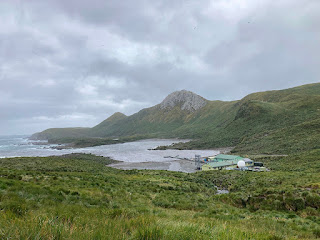
Since August 2008 I have spent a number of seasons working on Signy Island (South Orkney Islands) and Bird Island (South Georgia) for the British Antarctic Survey (BAS) as a Zoological Field Assistant on the penguin, seal and albatross long-term monitoring programme. More recently I did a short season at Bird Island in Janary 2024 and in November 2025 I returned to Signy Island. In November 2026 I am heading to the Antarctic Continent to study snow petrels and Antarctic petrels.

This blog gives readers an insight into my day-to-day life in the Antarctic, from my first trip south in 2008 to the present day.

Thursday, 21 March 2024

Leaving Bird Island and adventures

On Monday morning the “big red taxi” arrived at Bird Island.  This is the new polar research ship, the RRS Sir David Attenborough (the SDA).  I’ve not seen her before as she was still being built last time I came South, so I am pretty excited to be travelling home on her. 

The day of the last ship before winter dawned grey and foggy…

…and the SDA appeared out of the gloom like a huge red shadow.  


Boats were soon sent ashore and we all set to work.  The last ship call of the season is always busy as all the cargo and waste from the summer season has to be dragged down to the end of the jetty by hand to be shipped away and supplies come in for the four people who are staying for the winter.  Additional people from the ship come ashore to help out.

After a long and busy day, the work was complete, and the nine of us that were departing, said our fond farewells to the winterers and headed onboard the SDA.  Some people have been at Bird Island for 18 months, and the Bird Island family of friends becomes torn apart so this is always a bit of an emotional time for everyone as people head back to the big wide world.

The new SDA ship is enormous, very new and very civilised, rather like a floating hotel!  We were given our cabins and soon settled in.  Overnight we set sail, heading east along the north coast of South Georgia, towards the research station there at King Edward Point.  The weather had also decided it was winter, and by the next morning, snow had started to fall, both back at Bird Island, and on the ship.

South Georgia is breathtakingly beautiful and the journey to King Edward point was filled with lovely icebergs.  The weather here is notably much sunnier than at Bird Island, despite only being approximately 50 miles along the coastline.    
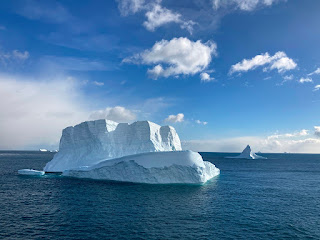
As the ship was ahead of schedule we detoured round to get a glimpse of some of the disused whaling stations that are present at Leith, Stromness and Husvik from the ship along the way. 

These are protected sites (and very dangerous) so we were not allowed to land, but it was lovely to get a glimpse of them from onboard.  Afterwards we continued to King Edward Point, where we are staying for a few days.  We have been having some fun expeditions here, so I’ll put some pictures of our adventures there on the next blog.  Meanwhile the webcam is still up and running for those wanting to follow the journey. 

https://www.bas.ac.uk/data/our-data/images/webcams/rrs-sir-david-attenborough-webcam/


Monday, 18 March 2024

Homewards

Today our long journey home begins. 

The new polar research vessel, RRS Sir David Attenborough is due to arrive at Bird Island today for “last call”.  Last call is the final ship visit of the summer season and is when everyone except the wintering team of 4 people leave the island.  There will be 9 of us departing.  We have been preparing cargo and getting ready to leave for a while now and are now prepared and ready.

You can follow the ship webcam here:

https://www.bas.ac.uk/data/our-data/images/webcams/rrs-sir-david-attenborough-webcam/

Unlike the journey south, which took less than a week, our journey home is quite an adventure and it will be almost 4 weeks before we get back to the UK.  Once we leave Bird Island, we will be doing a round of the other BAS research stations- at King Edward Point, South Georgia, then onwards down to Signy Island in the South Orkney Islands (where I have also worked previously), before returning to the Falklands.  It should be a lot of fun!


Sunday, 10 March 2024

Days out

We have had some lovely weather at Bird Island this summer, and as a result have been getting out and about across the island, both for work, and on our days off.

Bird Island is small and its peaks are more like hills than mountains in height, but the terrain can be dramatic and rocky and a day out can be quite exciting if you aren’t on the main paths.  One sunny day, a group of us decided to walk the Five Peaks, which are the five biggest on the island and form a ridge along its length.  The peaks at the eastern end are rocky, giving way to lower, greener peaks to the west.  These were our first two peaks, Tickell and La Roche.

This is the view from La Roche, the highest point on the island, looking west.  You can see the research station which is where we live, down in the bay, and the smaller peaks of Gazella, Tonk and Molly Hill beyond.  In the distance lies the Willis Islands, and beyond that, there is nothing at the same latitude until you’ve travelled right round the world and back to South Georgia again!

Looking east from La Roche you can see the rest of mainland South Georgia, separated from us by only 500m of water, but still too far away for us to get to.

And here is La Roche, which provides the backdrop to most of our views.  Again the research station can be seen in the bay.

We have had some nice sunsets recently…

And some very nice icebergs…

…which the penguins and seals love when they wash up on the beaches.

It is now only a couple of weeks til we leave Bird Island, so we have all started preparing for the end of the season.  When we depart, just the four wintering team will remain.  We are expecting an exciting three week journey home, travelling on the RRS Sir David Attenborough, via the research stations at King Edward Point on South Georgia, and my old haunts- Signy Island, in the South Orkney Islands.

Wednesday, 28 February 2024

Late summer

As we reach late February, the summer here is already starting to draw to a close.  The weather has become quite wild and windy, and today it was only just above freezing and the showers were falling as snow.  The days are getting shorter, and it’s still fairly dark at 7am when I get up, and getting dark again by 9pm.  The wildlife that has been breeding this summer is growing well, with our first chicks already ready to leave the island.

The gentoo chicks have grown quickly, and are now learning to swim and feed themselves.  They are now fully feathered and look very much like the adults.  The adults are now the ones that look scruffy- once they have finished breeding, they come ashore for a few weeks to moult all of their old feathers and replace them with new.  For a while they look quite rough- this shows one that has finished moulting, and one that is partly moulted.

The macaroni penguin chicks have grown well.  In this picture you can see how big they were a couple of weeks ago (there are adults and chicks in this colony- the adults have yellow crests).

The Macaroni chicks are now ready to leave the island and we have been watching them take their first dip in the sea.  For them this is much more of a commitment- while the gentoos can just take an easy paddle and swim in the shallows of a sheltered beach, the first encounter of the sea for the macaroni chicks is a big leap off a ledge into the churning ocean below.  The Macaroni’s breed in enormous colonies- this is Big Mac, our biggest colony, home to around 30,000 pairs of penguins.  The colony appears pink due to the guano, because they eat krill (a pink shrimp-like creature).  Each tiny dot is a macaroni penguin nest.

The giant petrel chicks take a little longer than the penguins to develop.  Some are still quite small and fluffy…

While others have now lost their downy fluff and are showing their feathers.  It will be another month before these fledge.

The Antarctic fur seals that live around us have changed from little black fuzzy creatures to very smart little soft grey seals that are also now happily playing in the water.  They have enormous amounts of character and are very comical to watch.


We are now only a few weeks from the end of the season and are already starting to finish off projects and start packing cargo to send out on the ship- I’m not quite sure where the last couple of months have gone!  We’ve also had some fun days out exploring the less visited areas of the island on nice days, and I’ll put some pictures of those on here soon. 

Sunday, 11 February 2024

Working at Bird Island

I have now been back at Bird Island long enough for it to feel like home, and I am still very pleased to be here.  I am one of six zoological field assistants here, and between us we conduct long term monitoring studies of the various wildlife.  Out work is largely divided into three topics, with two field assistants working on each.  My role is to work on the penguin and petrel monitoring, with the other two topics being the seals and albatrosses.  Normally these positions are 18 months long, spanning two breeding seasons with a winter in between, but I am filling a short term gap left by a someone else having to leave early.  The work is nice because in addition to having our own responsibilities, there is plenty of opportunity to get involved in everyone else’s too.

The wildlife that comes to Bird Island each season to breed has been intensively studied for nearly 70 years, and a permanent, purpose built research station exists here to facilitate this. 

Much of our work is long term monitoring, with the same groups of birds and seals studied each season over many years.  Studying a sub-set of the populations is a manageable way of allowing us to see the wider picture of how the various species are doing.  We can compare data over many years and monitor the long term trends in the population size and breeding success of each species.  As similar data is collected at other research stations around Antarctica, when combined, we can get an overall picture of the health of the Antarctic ecosystems as a whole.

Maintaining the long term data sets involves following each species through the breeding season, with various important counts along the way that tell us how the birds are doing and attempts to explain good/poor breeding season.  For the penguins, this starts in spring (November).  We weigh adult penguins who have returned to breed (the heavier the birds on arrival, the better condition they are in for breeding).  We then monitoring the start of the nesting season (to get first egg laying dates etc (to enable subsequent population counts to be consistent across the years).  Later we do nest counts of certain colonies once the birds have all returned and settled.  Further through the season we conduct chick counts of the same nests once the eggs have hatched (in a good year where food is plentiful, gentoo penguins can successfully rear two chicks, in a poor food year they manage to raise only one to fledging, or none at all).  Fledgling counts of the same colonies are then done to see how many chicks per pair survive (by now we are in January), and finally chick weighing to see how heavy they are (and therefore what condition they are in) when they are ready to fledge at the end of the season.  The penguins mostly nest on the beaches by the shore (gentoo penguins)…

or on rocky areas (macaroni penguins).

The giant petrels (and many of the other flying birds studied here) are monitored in a slightly different way to the penguins.  For these, we walk their nesting area daily early in the breeding season, and mark each nest with a numbered stake on the day the egg is laid.  The giant petrels build individual nests of moss across the meadows.  

Each individual nest is then monitored through the breeding season until the chick (hopefully) fledges at the end of the summer.  We put uniquely numbered leg rings on these birds and their chicks.  This enables us to see how the birds interact with each other, who is breeding with who, and how long they live.  Ringing chicks provides valuable data as it means we know exactly how old they are.  Most albatrosses and giant petrels return to where they hatched to breed.  This is a nesting pair of wandering albatrosses.

Our oldest albatrosses were ringed as chicks in the 1960’s and some of our oldest breeders are now 60 years old- it is a real privilege to be able to see and work with these birds. 

In addition to the long term monitoring programme, we study other species, and other aspects of the wildlife’s behaviour, but I’ll write more about that another time.