Between August 2008 and April 2018 I spent a number of years working on Signy Island (South Orkney Islands) and Bird Island (South Georgia) for the British Antarctic Survey (BAS). I worked as a Zoological Field Assistant on the penguin, seal and albatross long-term monitoring programme. After a 5 year break, I headed back down to Bird Island in Janary 2024 for another dose of penguin work and in November 2025 I returned to Signy Island for 2 months.

This blog gives readers an insight into my day-to-day life in the Antarctic, from my first trip south in 2008 to the present day.

Sunday, 10 March 2024

Days out

We have had some lovely weather at Bird Island this summer, and as a result have been getting out and about across the island, both for work, and on our days off.

Bird Island is small and its peaks are more like hills than mountains in height, but the terrain can be dramatic and rocky and a day out can be quite exciting if you aren’t on the main paths.  One sunny day, a group of us decided to walk the Five Peaks, which are the five biggest on the island and form a ridge along its length.  The peaks at the eastern end are rocky, giving way to lower, greener peaks to the west.  These were our first two peaks, Tickell and La Roche.

This is the view from La Roche, the highest point on the island, looking west.  You can see the research station which is where we live, down in the bay, and the smaller peaks of Gazella, Tonk and Molly Hill beyond.  In the distance lies the Willis Islands, and beyond that, there is nothing at the same latitude until you’ve travelled right round the world and back to South Georgia again!

Looking east from La Roche you can see the rest of mainland South Georgia, separated from us by only 500m of water, but still too far away for us to get to.

And here is La Roche, which provides the backdrop to most of our views.  Again the research station can be seen in the bay.

We have had some nice sunsets recently…

And some very nice icebergs…

…which the penguins and seals love when they wash up on the beaches.

It is now only a couple of weeks til we leave Bird Island, so we have all started preparing for the end of the season.  When we depart, just the four wintering team will remain.  We are expecting an exciting three week journey home, travelling on the RRS Sir David Attenborough, via the research stations at King Edward Point on South Georgia, and my old haunts- Signy Island, in the South Orkney Islands.

Wednesday, 28 February 2024

Late summer

As we reach late February, the summer here is already starting to draw to a close.  The weather has become quite wild and windy, and today it was only just above freezing and the showers were falling as snow.  The days are getting shorter, and it’s still fairly dark at 7am when I get up, and getting dark again by 9pm.  The wildlife that has been breeding this summer is growing well, with our first chicks already ready to leave the island.

The gentoo chicks have grown quickly, and are now learning to swim and feed themselves.  They are now fully feathered and look very much like the adults.  The adults are now the ones that look scruffy- once they have finished breeding, they come ashore for a few weeks to moult all of their old feathers and replace them with new.  For a while they look quite rough- this shows one that has finished moulting, and one that is partly moulted.

The macaroni penguin chicks have grown well.  In this picture you can see how big they were a couple of weeks ago (there are adults and chicks in this colony- the adults have yellow crests).

The Macaroni chicks are now ready to leave the island and we have been watching them take their first dip in the sea.  For them this is much more of a commitment- while the gentoos can just take an easy paddle and swim in the shallows of a sheltered beach, the first encounter of the sea for the macaroni chicks is a big leap off a ledge into the churning ocean below.  The Macaroni’s breed in enormous colonies- this is Big Mac, our biggest colony, home to around 30,000 pairs of penguins.  The colony appears pink due to the guano, because they eat krill (a pink shrimp-like creature).  Each tiny dot is a macaroni penguin nest.

The giant petrel chicks take a little longer than the penguins to develop.  Some are still quite small and fluffy…

While others have now lost their downy fluff and are showing their feathers.  It will be another month before these fledge.

The Antarctic fur seals that live around us have changed from little black fuzzy creatures to very smart little soft grey seals that are also now happily playing in the water.  They have enormous amounts of character and are very comical to watch.


We are now only a few weeks from the end of the season and are already starting to finish off projects and start packing cargo to send out on the ship- I’m not quite sure where the last couple of months have gone!  We’ve also had some fun days out exploring the less visited areas of the island on nice days, and I’ll put some pictures of those on here soon. 

Sunday, 11 February 2024

Working at Bird Island

I have now been back at Bird Island long enough for it to feel like home, and I am still very pleased to be here.  I am one of six zoological field assistants here, and between us we conduct long term monitoring studies of the various wildlife.  Out work is largely divided into three topics, with two field assistants working on each.  My role is to work on the penguin and petrel monitoring, with the other two topics being the seals and albatrosses.  Normally these positions are 18 months long, spanning two breeding seasons with a winter in between, but I am filling a short term gap left by a someone else having to leave early.  The work is nice because in addition to having our own responsibilities, there is plenty of opportunity to get involved in everyone else’s too.

The wildlife that comes to Bird Island each season to breed has been intensively studied for nearly 70 years, and a permanent, purpose built research station exists here to facilitate this. 
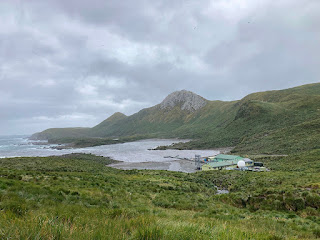
Much of our work is long term monitoring, with the same groups of birds and seals studied each season over many years.  Studying a sub-set of the populations is a manageable way of allowing us to see the wider picture of how the various species are doing.  We can compare data over many years and monitor the long term trends in the population size and breeding success of each species.  As similar data is collected at other research stations around Antarctica, when combined, we can get an overall picture of the health of the Antarctic ecosystems as a whole.

Maintaining the long term data sets involves following each species through the breeding season, with various important counts along the way that tell us how the birds are doing and attempts to explain good/poor breeding season.  For the penguins, this starts in spring (November).  We weigh adult penguins who have returned to breed (the heavier the birds on arrival, the better condition they are in for breeding).  We then monitoring the start of the nesting season (to get first egg laying dates etc (to enable subsequent population counts to be consistent across the years).  Later we do nest counts of certain colonies once the birds have all returned and settled.  Further through the season we conduct chick counts of the same nests once the eggs have hatched (in a good year where food is plentiful, gentoo penguins can successfully rear two chicks, in a poor food year they manage to raise only one to fledging, or none at all).  Fledgling counts of the same colonies are then done to see how many chicks per pair survive (by now we are in January), and finally chick weighing to see how heavy they are (and therefore what condition they are in) when they are ready to fledge at the end of the season.  The penguins mostly nest on the beaches by the shore (gentoo penguins)…

or on rocky areas (macaroni penguins).

The giant petrels (and many of the other flying birds studied here) are monitored in a slightly different way to the penguins.  For these, we walk their nesting area daily early in the breeding season, and mark each nest with a numbered stake on the day the egg is laid.  The giant petrels build individual nests of moss across the meadows.  

Each individual nest is then monitored through the breeding season until the chick (hopefully) fledges at the end of the summer.  We put uniquely numbered leg rings on these birds and their chicks.  This enables us to see how the birds interact with each other, who is breeding with who, and how long they live.  Ringing chicks provides valuable data as it means we know exactly how old they are.  Most albatrosses and giant petrels return to where they hatched to breed.  This is a nesting pair of wandering albatrosses.

Our oldest albatrosses were ringed as chicks in the 1960’s and some of our oldest breeders are now 60 years old- it is a real privilege to be able to see and work with these birds. 

In addition to the long term monitoring programme, we study other species, and other aspects of the wildlife’s behaviour, but I’ll write more about that another time.


Tuesday, 30 January 2024

Bird Island

I have now been back at Bird Island for over a week and am very much settled back into life here.  I’m conscious that I have a new set of followers of my blog and many of you will be unfamiliar with much of the work I have done in the past and where I am.  Therefore I’ll try and explain a bit about it all in my next couple of blogs.

Bird Island is a small sub-Antarctic island that lies at the western end of South Georgia, to the south east of the Falkland Islands in the southern hemisphere. 

The island is small, about 3 miles long and about half a mile wide, separated from mainland South Georgia by a 500m stretch of water.

Bird Island is home to vast volumes of internationally important wildlife and a small group of seal and seabird scientists (working for the British Antarctic Survey) live and work at the research station here to study them.  Being in the southern hemisphere it is now summer, so we have quite long hours of daylight.  The weather is relatively mild at this time of year (between about 0 and 5 degrees), and usually quite windy and rainy.  When the sun shines the island takes on a green, almost tropical look, and is very beautiful.  Icebergs can be seen all year round.  Much of the island is covered in deep tussac grass with mossy wet meadows and small ponds.  During the winter months, the island is frequently snow and ice covered, but at this time of year this usually falls as rain.

Bird Island on the day we arrived.

The research station is modern and comfortable, and this season there are 13 of us here.  The group is made up of 7 seal and bird scientists studying the wildlife (me), the station leader (who keeps everything running smoothly on station), and a project team of 5 who are installing solar panels and working on other infrastructure projects on the station. 

The island is sloping, with rocky beaches along the southern coastline…

Which rise up to huge cliffs that plunge into the sea, all along the northern coastline.

The island is filled with a melee of wildlife, including seals, albatrosses and penguins who come to the island to breed each year.  The meadows are used by breeding wandering albatrosses and giant petrels.  Black-browed, grey-headed and light-mantled sooty albatrosses nest on the steeper ground.  Beneath our feet, smaller burrow-nesting petrels and prions (like tiny albatrosses) make their home.  In summer the beaches are busy Antarctic fur seal breeding colonies, and elephant seals also breed.  Leopard seals visit the shores during the winter months.  Gentoo, macaroni and chinstrap penguins nest on the beaches, while large groups of king penguins also hang around (but do not breed).  There is also an endemic South Georgia pintail duck, and a small songbird, the South Georgia pipit. 

The island is therefore a delightfully busy, and noisy place!  I’ll write about my work here in my next blog, but meanwhile here are a few penguins for those that have asked for them.

Saturday, 20 January 2024

The journey south

I have now safely arrived and settled in at Bird Island, South Georgia, which is to be my home until April.  The 9000 mile journey began last Tuesday when my luggage and I were dropped off at Darlington train station by Adam and I caught the train down to my parents in Lincolnshire.  The next day my parents took me to Cambridge, which is where the British Antarctic Survey offices and labs are.   Here I met a small group of other BAS staff who were also heading south and we were taken to RAF Brize Norton in Oxfordshire.  Here we met more BAS staff and boarded the plane.  By now our group size had increased to 9 people, all of us heading for South Georgia.

The plane was a relatively ordinary military version of the Airbus A330 (and not a Hercules, which some people have asked me). 


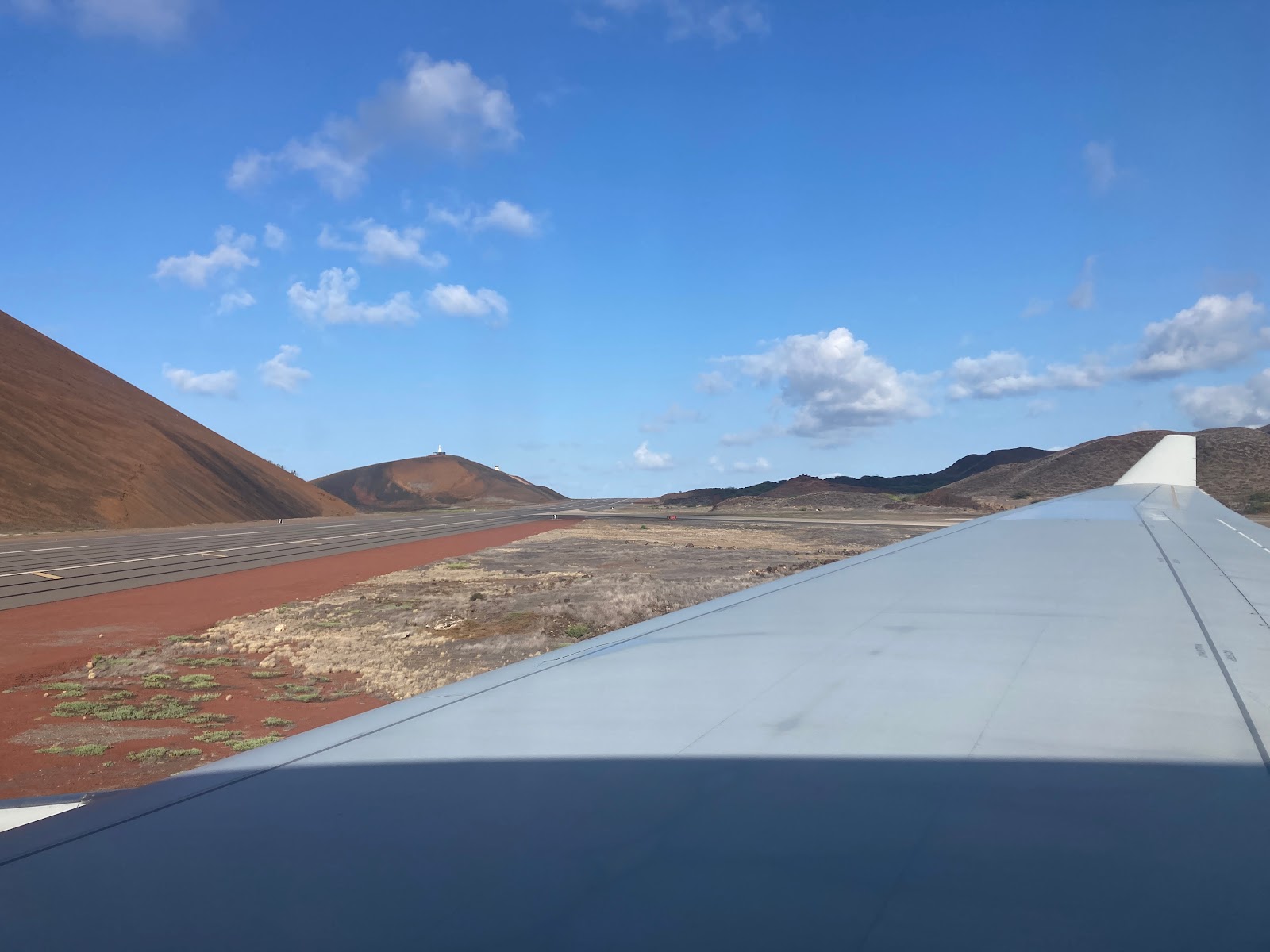
We passed a pleasant journey on a plane that was only half full, which was nice as it meant 2 seats each and just enough space to sleep on the journey.  The journey takes about 17 hours, with a short stop at Ascension Island for refuelling approximately half way there.   Ascension Island is a small rocky island far out in the Atlantic, a little south of the equator, and was a pleasant 26 degrees when we got off the plane. 

Sadly we aren't allowed out of the terminal to explore the island as we're still in transit but it was nice to get off the plane and stretch our legs (I did spend a week on the island on a previous trip so I didn't feel I missed out too much by it only being a very short stop on this occasion).    

Once the plane was refuelled, we continued on our way to Mount Pleasant Airbase in the Falkland Islands.  Another bus journey from Mount Pleasant and we arrived in Stanley, the capital of the Falklands.  The Falklands are windswept and vast (like a larger wilder version of Shetland). 

The majority of its ~3500 inhabitants live in the capital, which sprawls along the seafront, in an array of brightly coloured, mostly wooden-clad buildings.  We spent one night in the Malvina hotel in Stanley, which was just enough time for a walk along the seafront, where I spotted my first penguin and seal.

The next morning we were on the move again (by now it was Friday).  This time onto the MV Pharos SG, the Fishery Patrol Vessel for South Georgia and the South Sandwich Islands.  We spent nearly 3 days onboard, heading from the Falkland Island to Bird Island which lies at the western end of South Georgia.  As the ship is quite small, and the swell was pretty big, the crossing was quite rough, but the time passed pleasantly enough. 

There are two research stations on South Georgia.  Four of us are heading for Bird Island Research Station while the remainder of the group are heading for King Edward Point Research Station.  The group heading there made our journey very interesting- they are whale scientists and were heading there to study humpback whales.  They were a very interesting bunch doing some fascinating science, and kept a permanent watch on the bridge of the ship for whales during the entire journey.  This was great as there was always someone there to tell everyone if whales were spotted.   The journey was mostly spent eating, or watching the birds that were following the ship.  This one is a wandering albatross.

As we got closer to South Georgia, there were quite a few icebergs.  I have never quite got over my fascination for icebergs.  Every one is different and the colours and shapes are ever changing with the light.

We finally arrived safely at Bird Island on Monday, where four of us disembarked the Pharos in small boats to our new home.  We receive a very warm welcome from those currently at the island and quickly settled down to life on station.